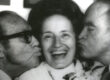
(Ed note: We thought you might enjoy this article written almost 50 years ago after I had interviewed perhaps the greatest prize fighter of all time. A fighter sweet as sugar, Sugar Ray Robinson)
Keeping Pace with Sugar Ray Robinson
by Frank Pace
First published LA Sports Magazine, August, 1976
This is a love story. It is the story of a man and his love for children. The man is no ordinary man. The children are. That’s what makes the story so special.
Pound for pound, Sugar Ray Robinson was arguably the greatest fighter of all time, a sporting legend. In a quarter century, 1939-1965, Ray Robinson won the World Welterweight Championship five times and then added the Middleweight Championship for good measure. His combinations were a classic version of speed, power and accuracy. His footwork rivaled that of Fred Astaire and Gene Kelly. His brain was a veritable boxing computer. When Sugar Ray fought, other fighters paid their way to see how it was done. He was Muhammad Ali’s idol! A fighter “as sweet as sugar.”
Born Walker Smith Jr., Robinson grew up in the same Detroit neighborhood that gave the world Joe Lewis, his lifelong friend. “I never wanted to fight anyone as a kid, even on the streets,” Ray said. “I just hated violence and didn’t mind saying I was sorry even if the other guy was wrong.” By the time he reached 15, young Walker became interested in boxing. Too young to fight under the auspices of the AAU, he borrowed an older friend’s I.D. card, and a legend was born. That friend’s name was Ray Robinson.
Throughout a storied fight career that brought wealth and recognition, Sugar Ray Robinson never forgot young Walker Smith and the hurt he felt when he couldn’t afford 25 cents a month to join the neighborhood YMCA. Ray always knew what he wanted to do when his fighting days were over.
Oddly enough, an invitation to England for a birthday celebration honoring Queen Elizabeth, in the late 1960s, set in motion a chain of events that led to the founding of what was to become Sugar Ray’s Youth Foundation.
Ray tells the story. “There was a lot of unrest in the states at the time, riots in the streets and violence on our campuses. Prince Phillip convinced me that I could do something about it. That’s when I realized that everything I had ever done in my life was in preparation for what I was about to begin. I was blessed by God with a talent which helped introduce me to people around the world. I felt it paramount upon myself to help ease the growing juvenile problem within our country. I knew there was an alternative to the continued locking up of juveniles. The answer was to work with them. Give them something constructive to do with their time. Something they could take pride in because the children are the future of our nation.”
If Ray became the heart of Sugar Ray’s Youth Foundation, Wright Fillmore became its soul. “What does a fighter know about developing such a program?” Ray asks. Before he left England that night Ray sent a wire to Los Angeles.
Wright Fillmore, as much as any man, is the patriarch of the Black community in L.A. So loved, he is simply called “Uncle Wright.” An elder in the church, there is wisdom in his years, wisdom Ray has leaned on heavily since those formative days. “I’ll never forget that wire from England,” Uncle Wright laughs. “Ray told me not to go fishing. He had something important he wanted to talk to me about, something he had been thinking about all his life.” Wright and Ray went to work under Fillmore’s assumption that “any plan scientifically drawn up and systematically carried out would always reach its goal.” Their goal was to help children become good citizens by imparting three principles they could follow into adulthood: Respect, Kindness and Friendship.
Ray’s dream came true in 1969 when the State of California granted Sugar Ray’s Youth Foundation it’s tax exempt status. The idea that was conceived on the royal throne of England began in Wright Fillmore’s back yard. It became the lifeblood of Ray’s existence.
Now established in Los Angeles and Orange counties, Las Vegas and soon San Francisco, Ray estimates over 150,000 children have benefited by the foundation in a variety of activities ranging from track and field to beauty pageants and fashion shows. As it was at the beginning, Ray’s job is to raise the capital required to keep the program alive. “I love to talk to men,” the Sugar Man says, “because they were all boys once. They know doggone well that’s one part of life doesn’t change at all, and it’s not really hard to enlist their help.” Since 1969 neither Ray Robinson nor Wright Fillmore have accepted one cent as trustees of the foundation.
The 1972 Olympics saw an American boxer, Ray Seales, win a Gold Medal. In 1976 Ray Leonard fought his way to Olympic stardom. They shared a common nickname – Sugar Ray. “Hey, It’s a blessing. It gives me a wonderful feeling to know that the kids would want to take that name. You see, that’s my life’s work, to lead by example. I love to see the kids active in organized programs like the Olympics.”
Ray is currently working with Gov. Brown and Senator Leo McCarthy in hope of developing a Jr. Olympics for the State of California. His smile widens in anticipation. “Could you imagine an organized program statewide?” What an incentive for our children to qualify in their own home counties for these Jr. Olympics. All boys and girls thrive on recognition. These games would give them something constructive to do with their time while working toward that goal of accomplishment and recognition so vital to their development. I know my biggest thrill came in youth sports when I won the featherweight championship of the Golden Gloves.”
Despite the 70-hour week Ray devotes to the youth activities, he still likes to lace up the gloves when he gets the chance. “I love to hit the speed bags,” Robinson says. “They don’t hit back. I believe if I can work out everyday, I’ll live to be 200.”
The sign above the small building at 1905 10th Avenue in Los Angeles simply reads, “Sugar Ray’s Youth Foundation – Imparting Values Through Sports.” There are no pretensions to the building or the man. Walk through the door and you are greeted by Ray himself. He has dedicated his life to the development of our youth, and they couldn’t have a bigger fan or a better friend.
It is said that the true mark of a champion is his ability to stand the test of time. Now 40 years after his first fight, Sugar Ray Robinson is still a champion.
Editor’s Note: Sugar Ray Robinson died on April 12, 1989 in Los Angeles from complications of diabetes and Alzheimer’s disease. He was 67. Robinson was elected to the International Boxing Hall of Fame in 1967 and the Georgia Sports Hall of Fame this year.